This was not my first self-created Google Earth lesson (see my former post), but definitely one of my first lesson resources that I geared the objectives to cover more than just the Earth Science standards. This summer has brought my graduate studies full circle with a Globalization course. At first, I thought that I was going to highly dislike this course due to its political roots, but reflectively I feel that I have learned the most from this course. While creating this lesson, I kept many of the ideals of globalization and my students' probable futures at the forefront while still maintaining the rigours of science standards. This lesson is something that I dreamed of and planned for, but just never had the time this summer to develop the materials.
This lesson was a great way to end this course because it gave me the time to dedicate towards materials needed to execute this lesson. Tools that were relatively new for me to develop were mainly synthesizing the online resources into stops; creating links, embedding images and educational simulators; and assigning an online assessment tool all within the Google Earth application. I found the aggregation of resources the most time consuming aspect of this activity. The most difficult part of this process was figuring out how to post the file on a blog format - so hopefully it works! Generally, when I create a file like the Google Earth tour, I find that I can actually upload the file to my classroom website and wiki with ease. A blog only allows you to link to web files instead of uploading, and therefore, I had to find an online file host, Google Sites File Cabinet, to upload the file and then link to that from this blog. My research on how to do this was not a waste. During my time on forums to answer this question, I also found out that you can embed a Google Earth widget into many of the blog spaces. I feel that this will be very useful when I am linking something that is not as interactive as the current file. I could see embedding it on a blog when I am just trying to create a relevance to distance or one single image instead of a tour. I am not sure that our schools server could handle 30 computers trying to access the same blog with the same overloaded widget.
I feel that Google Earth is a supreme application with its versatility and availability to download for free. I am hoping to take this same idea of a lesson on global warming via Google Earth and modify it to fit the link on the top 10 causes and effect of global warming. This website was a great resource that I discovered while finding resources on the internet for this project, but I already had the idea for the other stops in place. I also like the fact that the Discovery Education Assignment Builder allows a paperless transaction. I plan on integrating this into my case studies lesson that I generally print materials out for.
Enjoy the Google Earth tour below :)
KMZ File
Friday, August 9, 2013

Thursday, August 8, 2013
Saturday, August 3, 2013
EDIM 508 - Science is a Universal Language
 There are days that I count my lucky stars that I get to teach and excite students about science - today is one of them. After reading the chapter on The Respectful Mind in Howard Gardner's Five Minds for the Future, I have highly reflected on compliments co-teachers have given me in the past. Many of the compliments have contained sentiments that whatever the situation or student may be, I act and react in a respectful manner and expect the same of my students. It is an atmosphere that is hard to define and thus maintain, and I have to ask and remind myself multiple times throughout the school year what is respect? For me it is the root and essence of success in the classroom. It is a structure and foundation that is exemplified in hopes that students will determine for themselves that respect is an aptitude that is for the greater good. Respect sometimes seems difficult to define, but is essence is define by Gardner as, "[someone] that offers the benefit of the doubt to all human beings" (Gardner 2009).
I also find myself fortunate enough to work in a team setting at the 9th grade level. Over the last few years, we have been developing an academy setting for our students to engage the student body in a successful transition into the high school atmosphere. It did not hit me until reading this week's references, that in all of the trials and struggles of developing that academy atmosphere and honor code, that the core -which is sometimes lost- is truly based on respect. These values are those that are instilled by modeled values of my coworkers, and that is where I get to count my lucky stars again. A large overhaul for the academy this upcoming year is contributing in community service, and that, again, is the heart of respect for others.
Overall, my fortunes land in teaching science, or what is said to be a universal language. I get to teach a subject that is common and collaborative throughout the world. Julene Reed describe two major facets of respect in the following passage: "Knowledge of other cultures around the world leads students to understanding and compassion" (Reed, 2007). She also encourages teachers to promote a global respect within the classroom. No greater global respect can be emulated to my students than producing and reading research that is aggregated by students, just like them, from all over the world. The Globe Program is an online education center where students contribute scientific evidence and collaborate with other students from around the world to benefit the environment. Integrating this program in the classroom provides an opportunity for a flat classroom environment while still committing to the science standards. The program increases excitement, engages a commitment to the environment, and promotes respect throughout the scientific community that is global.

References:
Gardner, H. (2009). Five Minds for the Future [Kindle DX Version]. Cambridge, MA: Harvard Business School Press.
Reed, J. (2007, September 28). Global collaboration and learning. Retrieved from http://www.edtechmagazine.com/k12/article/2007/09/global-collaboration-and-learning
The globe program. (n.d.). Retrieved from http://www.globe.gov/
Sunday, July 28, 2013
EDIM 508 - Holy Glog!
Over the past two weeks in EDIM 508 - Digital Media, we have been discussing ways to integrate and foster Howard Gardner's creative mind into our own classroom. Previously we have polled students, written blogs, and drummed up discussions with classmates. This week was a whole 'nother beast... the Glog! A glog, is a busy dizzying virtual poster that puts you in the makers-seat. Glogs can be used a learning centers or a means for students to present ideas and uses all types of media within them. This type of project really would allow the students to develop their creative mind, because the possibilities are endless and there are only a few items that have limits on the glog - the choice is theirs. The creative mind wants to be free and develop with out rules - Glogster provides the medium for just that.

View my first glog!
The glog was challenging, and this is not truly my first glog - I had helped in another glog challenge collaboratively. But this time I was on my own. I am pleased with the overall project and know that the students will really like the learning center that I have produced for them - rather than taking notes from a PowerPoint. I did find difficulty in uploading the video and it seemed to take forever. If I am going to implement more glogs into the classroom, I am going to have to help students manage their time and tasks in class that day. I could see how students would get behind very easily with only one single technical glitch.
When students create glogs, the classroom is not only functioning with 100% participation, but the content also covers a multitude of standards above any chosen content:
Science as Inquiry: Standard - 3.3.10.A8:
- Compare and contrast scientific theories.
- Know that both direct and indirect observations are used by scientists to study the natural world and universe.
- Identify questions and concepts that guide scientific investigations.
- Formulate and revise explanations and models using logic and evidence.
- Recognize and analyze alternative explanations and models.

Inquiry and creativity go hand-in-hand in the classroom. Check out the article's quick Five Feature of Scientific Inquiry. All five points of inquiry led to a personal derivation of understanding. This could not be achieved without ones ability to think creatively and freely.
Image Credit: http://vimeo.com/20910554
EDIM 508 - Creative classrooms (Part 2!)
My student that I have deemed as 'mini-me' in my former post has taken the time to respond, and I would like to share that response with everyone. Plus I have decided that she is much more talented and creative than I ever allowed myself at that age :) I enjoyed her sassy first line in her email : "So, asking me to do more work on top of the summer assignment work that I already have to do? How very teacher-like of you. I'm just kidding, I put my answer in a Google docs."
"In the drawing classes that I have taken, our main source of inspiration and creativity came from each other. Discussion was almost always encouraged, and together we critiqued and improved each other’s work. Discussion of this kind still takes place in more traditional classes, though it is less frequent, and is what I value most as a source of creativity. In my experience, group projects that contained the right mixture of people turned out much better than what I could have done by myself. The combination of extra hands and extra minds means more ideas can be generated, and students are usually more comfortable asking questions and discussing ideas with their own peers.
New devices and digital media in the classroom can definitely serve as a source of ideas and new ways to present them. At this point students have a wide range of options available when it comes to presenting a project to the class, and often take advantage of them. But the main thing that I can think of that severely limits creativity inside and outside of the classroom are computerized tutors and learning tools, like ALECKS and SAM. The only creativity they support is finding creative ways to avoid doing them. They are repetitive and draining programs that take only one correct answer. If you do them at home for homework, you cannot try and find an explanation that makes it easier for you to understand, you get what they give you or search the internet for a better way to solve the problem. Conversations with a teacher or even peers often result in finding a new way to explain how to solve the problem, and a resulting ‘Aha!’ moment."
-A. Einsig
I also wanted to exemplify just how creative and talented she is. Here is her latest speed painting. Enjoy!
"In the drawing classes that I have taken, our main source of inspiration and creativity came from each other. Discussion was almost always encouraged, and together we critiqued and improved each other’s work. Discussion of this kind still takes place in more traditional classes, though it is less frequent, and is what I value most as a source of creativity. In my experience, group projects that contained the right mixture of people turned out much better than what I could have done by myself. The combination of extra hands and extra minds means more ideas can be generated, and students are usually more comfortable asking questions and discussing ideas with their own peers.
New devices and digital media in the classroom can definitely serve as a source of ideas and new ways to present them. At this point students have a wide range of options available when it comes to presenting a project to the class, and often take advantage of them. But the main thing that I can think of that severely limits creativity inside and outside of the classroom are computerized tutors and learning tools, like ALECKS and SAM. The only creativity they support is finding creative ways to avoid doing them. They are repetitive and draining programs that take only one correct answer. If you do them at home for homework, you cannot try and find an explanation that makes it easier for you to understand, you get what they give you or search the internet for a better way to solve the problem. Conversations with a teacher or even peers often result in finding a new way to explain how to solve the problem, and a resulting ‘Aha!’ moment."
-A. Einsig
I also wanted to exemplify just how creative and talented she is. Here is her latest speed painting. Enjoy!
Friday, July 26, 2013
EDIM 508 - Creative classrooms: A perspective from someone three decades old
 This week's post ask us to conversate with students about creativity in the classroom. Being summertime and working far from where I teach, this task would be challenging, but I had emailed a student that I have deemed as 'mini-me' thinking that she could get back to me on short notice. But, I assume she is out having fun this summer and not checking her email :) so our email exchange did not take place. In the spirit of thinking creatively, I gave the assignment a nostalgic twist and turned to my sister. Her first degree is in sociology, is a technical writer, and has recently enrolled in communications classes online. She discusses where old meets new and here are her adaptive perspectives:
I first asked her what she valued in her new online courses and how has technology allowed you to be creative.
Sometimes I feel as if it is overwhelming to create meaningful content myself that implements a high use of technology. I find that many educators, and at all levels, struggle with the changes and growth of technology and deem it easier to do what they have always done instead of adapting. However, this does not prepare anyone for the unforeseeable future and does not really tap into students' creative abilities. Technology has such a great span of resources, and ways to create that deeper meaning in the classroom. Check out Edutopia's article on Integrating Technology Across the Access Spectrum. They have very interesting ideas for all types of classrooms based on the amount of technology available to the classroom.
This led to me to my follow up question: if you could go back in time (back to high school) would you want technology in the classroom like it is today? What is one drastic change that you would make?
 "If I could go back in time…. that would be wonderful, no bills! I digress, I'm not sure that I would have learned better. I’m glad that technology has progressed enough so today’s students don't have to deal with an overhead projector and the boring outdated teacher to go along with it. I guess not having to lug around a bunch of text books would be great. So the use of a kindle-type item would make things a lot easier, especially when you left a book in your locker." - L. Gebhart
This last phrase allows me to think nostalgically about high school. Many times I find it hard to relate to the problems that my students have, unlike a textbook left in a locker, and I forget just how far we have come as a society. I find their 'teenage problems' are irrelevant because I just cannot relate to it due to the upgrades that technology has made. I find that their problems outside of school tend to be a bit more real than mine ever were at that age. Not only is creativity good to create a deeper sense of meaning, but it is an outlet for many students. When students apply their creativity they are able to feel free and forget about the things that bother them. So why should we not provide the environment for them to do so?
Images Credits:
http://www.outofoffice.co/
http://www.svencreate.blogspot.com/
http://www.digitaltrends.com/mobile/can-an-ereader-replace-college-textbooks/
Friday, July 19, 2013
EDIM 508 - Creative Minds Don't Think Alike
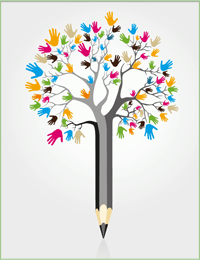 A few years ago if someone asked, do schools kill creativity; I would have answer yes. Now, I consider myself a pretty seasoned teacher at the peak of a change in the education system - preparing students for jobs that do not exist. In my classroom I have established a general curriculum and pacing guide for myself, and I can finally add creative touches to my lessons by keeping 21st century skills in mind when developing them. Sir Ken Robinson in one of his infamous TED Talks discusses that education was created during a time when skills were needed for the industrial era and general studies were established on this basis; and these skills are no longer the fulcrum that balances skills need for the current job market and what the education system actually produces (Robinson, 2007). The creative mind, which is not catered to enough in education, is the one that will continuously establish new ideas and ways to solve problems. The never ending creative mind is one that will be able to keep pace with the changing job market as stated in the following quote: Graduates today need to maximize their own creative potential, because jobs that don't require creativity are being outsourced and automated" (Sawyer, 2012). Creativity needs to stay in our schools at any cost. We, as a society, can not afford to prepare students for jobs of yesterday and today.
References:
Robinson, K. (Performer) (2007, January 06). Do schools kill creativity?. TED Talks. [Video podcast]. Retrieved from http://www.youtube.com/watch?v=iG9CE55wbtY
Sawyer, R. K. (2012, December 08). Schools that foster creativity. Huffington Post. Retrieved from http://www.huffingtonpost.com/dr-r-keith-sawyer/teaching-creativity_b_2258239.html
Image Credit
:www.beechlodgeschool.co.uk
global2.vic.edu.au
Sunday, July 14, 2013
EDIM 510 - Prezi Discovery
Prezi is a new form a communication enhanced by
collaborative technology. This website
allows the producer to aggregate different formats of resources into one
interactive poster. This poster can be
easily published and shared with others.
The Prezi presentation format supports the disciplined mind by allowing
them to choose how they spend their time and also allows them to show what they
know in a variety of formats. As a
teacher, for a Prezi project, students would have to have a certain number of
slides with specific content on them.
This would help focus the disciplined mind to concentrate on content
that is important. Prezis connects the
disciplined mind to the synthesizing mind by the overall format of a mind map
and flow that is created. The mind that
synthesizes is one that can collect information, sort relevant resources,
digest them, and be able to create connections. Students can easily collect resources,
integrate, and display them through the online creator. Prezis naturally create
connections through the templates and animations and are just as easy to alter
to create content areas and connections.
Prezis are an easy way to integrate project based learning into many of
the content areas and easily create a product.
They are fun to make and interesting to watch!
Check out my first Prezi
Check out my first Prezi
Thursday, July 11, 2013
EDIM 508 - Supporting the Synthesizing Mind
One of Howard Gardner's Five Minds for the Future is the synthesizing mind. A mind that has been exercised to synthesize is one that questions the norms, locates valuable resource to validate and refute, digesting the information, and creates connections to other valid points. For educators, synthesizing minds are the ones the create and innovate when we least expect it. Educators are responsible for providing opportunities for synthesizing minds to excel through projects. A self-created digital resource and project that encourages and helps develop this mindset is a Landforms Tour on Google Earth. Check the pinpoint file out at http://nesd.k12.pa.us/Page/2149. Students spend 3 days on this introductory activity. During this time they are expected to explore 20 pre-selected stops. At each stop there are guiding questions to help lead students, and students are required to create a sketch of what they see and shade relief, use tools to zoom in and out, assess the climate, and measure distances and height above sea level.
 One of my favorite comparisons, that really has the students synthesizing, is a gorge and canyon feature versus a meandering stream. Both of these features are created through the passing of water from the land to the oceans. During these stops students differentiate between the shape, structure, and depth of the rivers. Students greatest "Ah-ha" moments come when they use tools to determine the ratio or slope of the height above sea level divided by the length of the river.
 Most student can relate stream gradient to the landform structure before fully divulging in a lesson later in the unit. They can also conclude that white water rapids carry very little sediment in them compared to slower lazy river like the muddy Mississippi.
So many valuable observation and inferences are created during this three day introductory lesson. These lessons are carried and revisited throughout the unit and provide an effortless mound of questions from the students. Their level of inquiry is through the roof during this project! Their minds are vastly expanded as they travel on Google Earth and "play" to determine answers to questions that do not always have a right or wrong answer. Digital resources like these allow some students to excell and even possibly admit that they may like science, even if it is just a little bit :)
References:
Gardner, H. (2009). Five Minds for the Future [Kindle DX Version]. Cambridge, MA: Harvard Business School Press.


So many valuable observation and inferences are created during this three day introductory lesson. These lessons are carried and revisited throughout the unit and provide an effortless mound of questions from the students. Their level of inquiry is through the roof during this project! Their minds are vastly expanded as they travel on Google Earth and "play" to determine answers to questions that do not always have a right or wrong answer. Digital resources like these allow some students to excell and even possibly admit that they may like science, even if it is just a little bit :)
References:
Gardner, H. (2009). Five Minds for the Future [Kindle DX Version]. Cambridge, MA: Harvard Business School Press.
Thursday, July 4, 2013
EDIM 508 - Discovery Education - A Plethora of Resources!
Unit 2 - Assignment 1 - Blog on Digital Media
As I began this assignment, I logged into Discovery Education my traditional way and searched for Evolution of Stars video. I chose this topic because it is one that students cannot picture, relate to, or remember; even with my excellent story telling abilities, graphic organizers, and interactive demonstrations. Students lacked familiarity and the ability to comprehend the life of a star because they do not get to interact with the material and it is too abstract to understand happenings measured in light years for distance and billions of years for age! However, it is one of the most visually appealing items that I get to teach, I just cannot animate it for them. I decided to retrieve segments from the video section, and just so happened to stumble upon this, a Science Techbook.


Easy to navigate, I was able to find more than just videos. Units and chapters are organized and available for the taking and include more than just traditional resources. There are lesson plans, materials, teacher resources, five minute prep activities, and assessments. The tools for this website make it easy to integrate into your own classroom. After locating a resource, with a click of a button, it can be shared via social media or selected for online classrooms that you have set up. Virtual classrooms can easily be differentiate by ability. The nicest application is that they are set aligned with Pennsylvania State Standards.
The two digital media resources that I have selected are traditional classroom resources, but easily integrated for a classroom that is 'plugged-in'. The first resource is an article on The Life Cycle of a Star. It is a very quick read and can be adapted into an assessment very easily by using the websites Writing Prompt Builder tool. Traditionally, a teacher would print the article and have students respond via paper and pencil. With the Writing Prompt Builder, students could submit their work virtually and paper free! For lower ability classes, this same article could be viewed on an Interactive White Board, and the class as a whole could read, annotate, and highlight. Online MindMaps could be created in place of a traditional writing prompt.
 The second resource is a video on Extreme Stars. The video player gives the teacher the power to show the video in one entire setting, segments, or the ability to select certain clips. Videos at Discovery Education can also be assigned to particular virtual classrooms as a preemptive step to a lesson.
Teachers have the power to deliver the content in unique ways that there are millions of ways that students could demonstrate their mastery through a variety of products. Not only is availability, ease of creating unique lessons, and amount of resources and media some of the best assets of the online classroom, but the greatest feature is that with this type of classroom setting we are able to reach all students abilities and increase participation through a 'plugged in' interest. We not only need to meet the demands that all students have the right to learn in their own way, but equally indulge and power our students with the way of the future to prepare them for careers.
References:Discovery Channel, (2010). How the Universe Works: Extreme Stars. [Full Video]. Available from http://www.discoveryeducation.com/
Life Cycle of a Star. [Reading Passage]. Available from http://www.discoveryeducation.com/
Monday, June 24, 2013
EDIM 508 - Digital Media in the Classroom
Introductory Blog: 728 Challenge
- Who are you and what do you do?
Three seasons out of the year I teach ninth grade Earth Science, and for one short season I remodel our house and sleep-in! - What is your primary goal for taking this course?
To connect with my students interest, present content in a non-traditional way, and have students collaborate with one another. - What is your philosophy of education?
Bring your best and be your best by learning something every day. - What do you see as the greatest benefit of using technology and/or digital media in the classroom?
Student interest is increased and participation goes to 100% with use of technology. - What is your biggest concern or challenge with using technology and/or digital media in -the classroom?
If the technology does not work, generally, it cannot be fixed quickly enough, and by the time something goes "wrong" it is too late to transition into another lesson. - Provide an example of how you currently use technology and/or digital media in the classroom.
Myself and the students use the interactive whiteboard every day to display information. Google Earth is always up in the background for those "teachable" moments. - How does your classroom today differ from when you were the same age as your students?
Nothing is really the same except the cinder blocks and tiled floors. I brought my own materials and carried a heavy textbook. (Man, I sound like some old person!)
Subscribe to:
Posts (Atom)